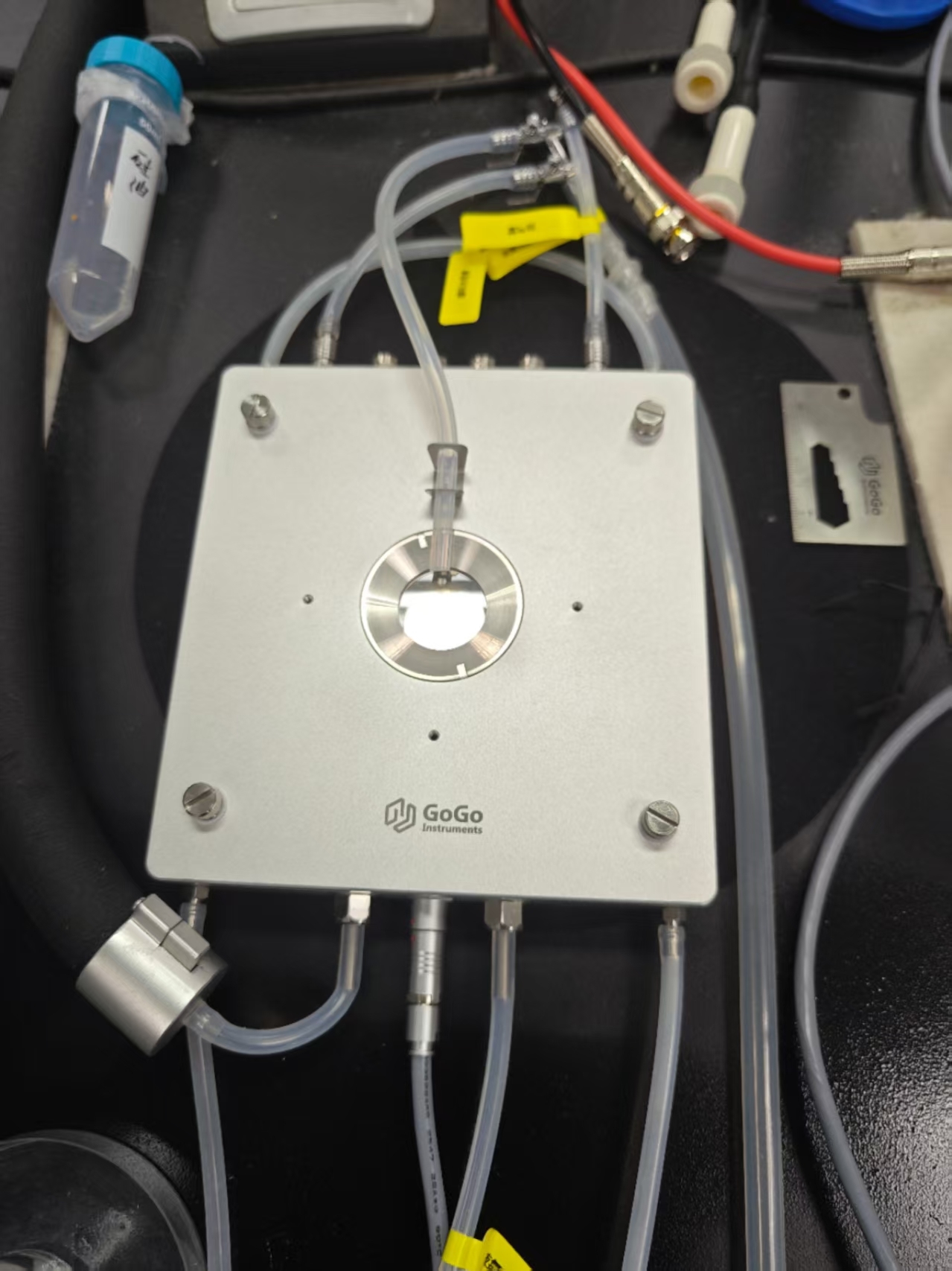
ECH600S Probe Stage Enables Research on Novel Superparaelectric High‑Entropy Energy Storage Ceramics
ECH600S Probe Stage Enables Research on Novel Superparaelectric High‑Entropy Energy Storage Ceramics Leave a Message We will call you back soon! Your message must be between 20-3,000 characters! Please check your E-mail!
ECH600S Probe Stage Enables Research on Novel Superparaelectric High‑Entropy Energy Storage Ceramics
Cases ECH600S Probe Stage Enables Research on Novel Superparaelectric High‑Entropy Energy Storage Ceramics
ECH600S Probe Stage Enables Research on Novel Superparaelectric High‑Entropy Energy Storage Ceramics
Northeastern University Team Designs Novel Superparaelectric High-Entropy Energy Storage Ceramics with Machine Learning – GoGo Instruments ECH600S Probe Stage Provides Key Variable-Temperature Support
Recently, the School of Materials Science and Engineering at Northeastern University (China) has made an important breakthrough in energy storage ceramic materials. The research team successfully developed a BaTiO₃-based superparaelectric high‑entropy ceramic with excellent dielectric energy storage performance using a machine learning‑assisted design strategy. The related work was published in the internationally renowned journal Energy & Environmental Materials (IF > 15) under the title: “Machine Lea rning‑Assisted Design of BaTiO₃‑Based Superparaelectric High‑Entropy Ceramics with Superior Energy Storage”. Click to view the original paper
The high‑entropy strategy is considered an effective route to improve the energy storage density and efficiency of lead‑free dielectric capacitors. However, the vast compositional space of high‑entropy systems makes it difficult to efficiently screen high‑performance materials using traditional trial‑and‑error methods. To address this challenge, the team employed a random forest regression model based on experimental data of BaTiO₃‑based ceramics. Four key descriptors – configurational entropy, tolerance factor, Pauling electronegativity, and valence electron concentration – were selected. Guided by the expected improvement acquisition function, iterative experiments were performed to quickly lock onto